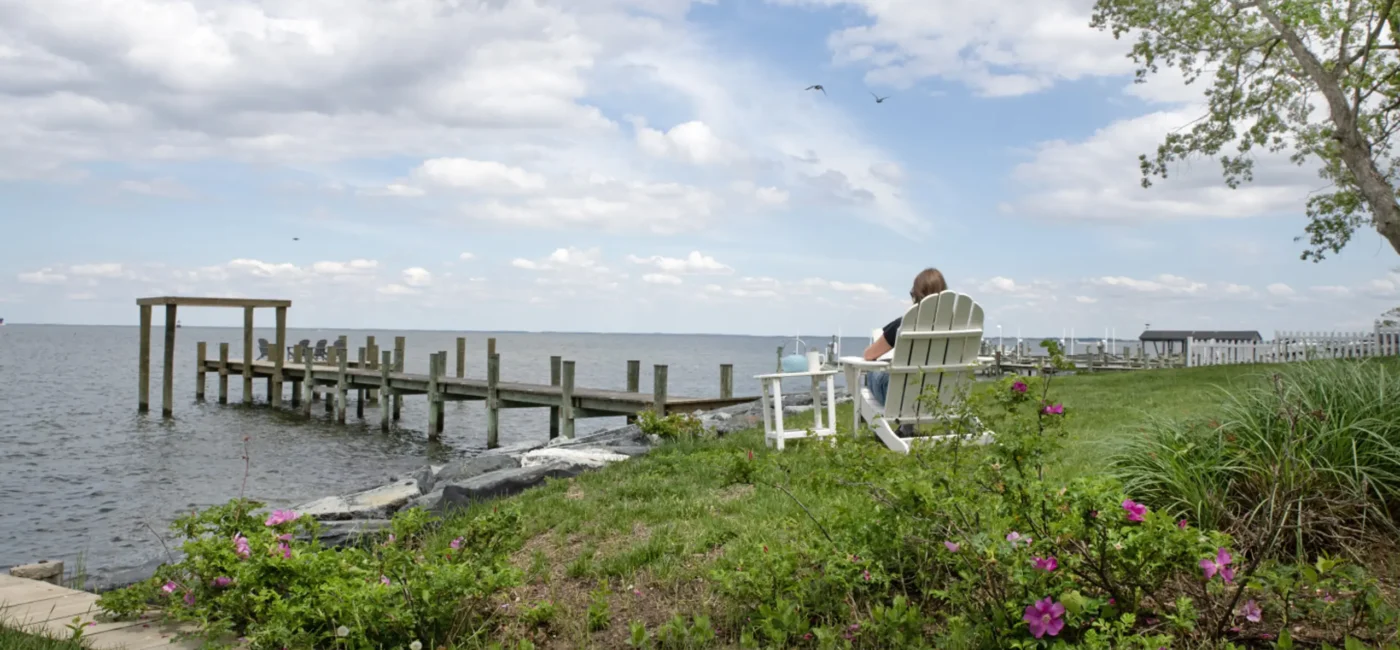
Blue crabbing on the Chesapeake Bay is one of the most satisfying outdoor traditions in the Mid-Atlantic. The Chesapeake Bay is the largest estuary in the United States and produces roughly one-third of the nation’s entire blue crab harvest every year. Whether you plan to drop a hand line off a dock or run a trotline by boat, the experience of catching Maryland blue crabs is accessible to beginners and rewarding for veterans.
Getting it wrong costs you a morning on the water and possibly a fine. Getting it right means a cooler full of jimmies, a pile of newspaper on the table, and a feast that locals have been staging the same way for a century. This guide covers everything: gear, licenses, the best spots near Annapolis, timing, cooking, and how to make it a full-day family outing.
Key Takeaways
- Maryland’s recreational crabbing season runs April 1 through December 15 in the Chesapeake Bay and its tidal tributaries.
- Blue crabs must measure at least 5 inches tip-to-tip to be kept during most of the season (5.25 inches from July 15 onward).
- An individual recreational crabbing license costs $5 for Maryland residents and $10 for non-residents in 2026. Hand lines and dip nets require no license at all.
- Peak crabbing near Annapolis runs from July through September, when crabs are fullest and most active.
- A private dock is one of the best crabbing platforms available: no crowds, no travel time, and you can check your traps on your own schedule.
- Steaming with Old Bay seasoning and a splash of apple cider vinegar is the definitive Maryland preparation.
Why the Chesapeake Bay Is Blue Crab Country
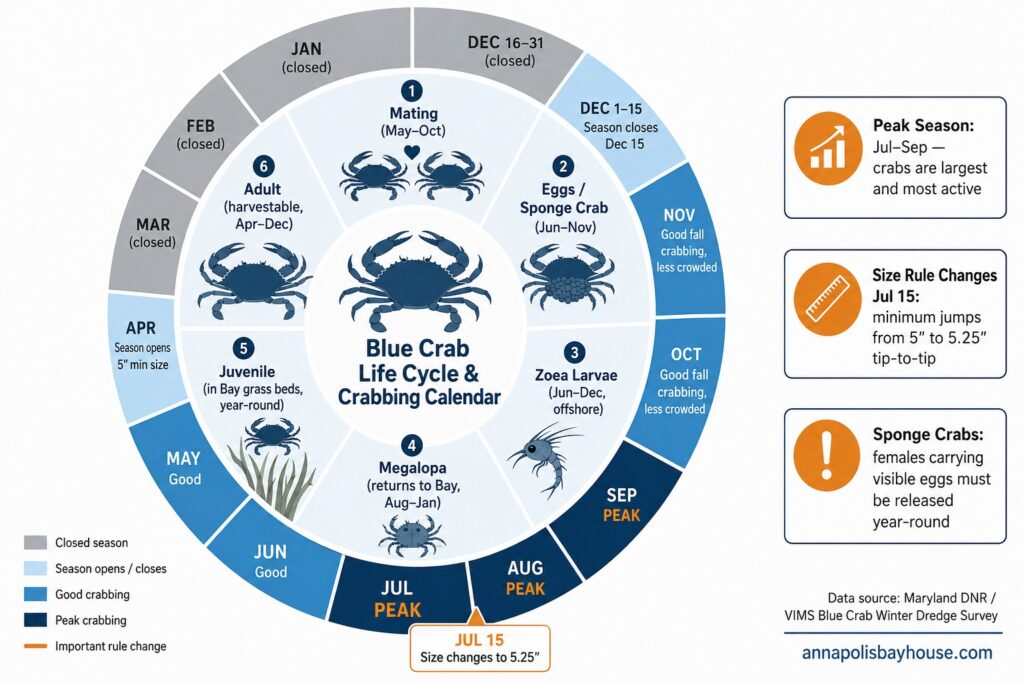
The Chesapeake Bay produces more blue crabs (Callinectes sapidus, meaning ‘beautiful savory swimmer’) than any other estuary in North America. The Bay’s combination of brackish water, extensive sea grass beds, and shallow tidal flats creates ideal feeding and nursery habitat for blue crabs at every life stage. An estimated one-third of the entire U.S. blue crab harvest comes from Chesapeake Bay waters shared between Maryland and Virginia.
The 2026 Blue Crab Winter Dredge Survey, conducted jointly by the Maryland Department of Natural Resources and the Virginia Institute of Marine Science, estimated the total Bay population at 349 million blue crabs. That figure is a 46 percent increase over the 2025 count of 238 million and signals a meaningful rebound after several lean years. For recreational crabbers, it means better catches throughout the season compared to recent summers.
Annapolis sits at the geographic heart of this fishery. The city and its surrounding waterways, including the South River, Rhode River, Magothy River, and Back Creek, all connect directly to prime crabbing habitat. Guests staying at a bayfront property with a private dock have immediate access to this ecosystem from the moment they arrive. For a complete guide to waterfront activities, sailing, and dining in the area, see our guide to things to do in Annapolis, MD.
Gear and Equipment – What You Actually Need
You do not need expensive equipment to catch blue crabs. A hand line, a dip net, and chicken necks will produce crabs from any dock or shoreline in Maryland. The table below shows what gear suits which situation and what each item does.
| Item | When You Need It | Notes |
| Chicken necks or fish heads | Always | Cheapest and most effective bait. Buy in bulk at any grocery store. |
| Hand line or cotton string | Shore / dock crabbing | No license required for hand lines and dip nets. |
| Collapsible trap / net ring | Dock or boat crabbing | License required. Easy to deploy and retrieve. |
| Trotline (50–300 ft) | Boat crabbing | Produces the largest hauls. Requires a boat and practice. |
| Long-handled dip net | All methods | Essential for scooping crabs off the line or from the water. |
| Bushel basket or cooler | All methods | Keep crabs cool and alive until cooking time. |
| Ruler or crab gauge | All methods | Maryland requires 5 inches (tip to tip) for most of the season. |
Chicken necks are the traditional bait of choice across the Chesapeake region. They are cheap, widely available, and hold up well in the water. Oily fish such as menhaden or bluefish also work and can be more effective in slack-tide conditions. Avoid fresh chicken breasts or supermarket shrimp, which fall apart too quickly.
One item worth adding: a 5-gallon bucket of fresh water. Live blue crabs stored in a cooler on ice can survive for several hours, but rinsing them briefly with fresh water before cooking removes mud and debris from the shell.
Maryland Crabbing License – What the Rules Say in 2026
Maryland law requires a recreational crabbing license for anyone using trotlines, collapsible traps, or net rings in the Chesapeake Bay and its tidal tributaries. Hand lines and dip nets are exempt from the license requirement entirely, which makes them the easiest starting point for first-time crabbers and anyone visiting from out of state.
| License Type | Fee | Who Needs It |
| Recreational Crabbing (Individual) | $5 resident / $10 non-resident | Anyone using trotlines, collapsible traps, or net rings. |
| Recreational Crabbing (Individual) — Reduced Rate | $2 resident | Maryland residents who already hold a Chesapeake Bay and Coastal Sport Fishing License. |
| Recreational Crabbing Boat License | $15 | Covers all individuals on board. Decal must be displayed on the vessel. |
| No license required | Free | Hand lines and dip nets only. Children under 16 may also use collapsible traps and net rings without a license. |
Licenses are valid for 365 days from the date of purchase. You can buy a license online through the Maryland DNR Compass System at compass.dnr.maryland.gov in a few minutes. Print it immediately or have it on your phone.
Beyond the license, the core size and bag rules for recreational crabbers in Maryland are:
- Minimum size: 5 inches tip-to-tip from April 1 through July 14; 5.25 inches from July 15 through December 15.
- Daily limit: 1 bushel of hard crabs per licensed individual, or 2 bushels per boat.
- Female crabs with visible eggs (sponge crabs) must be released immediately, regardless of size.
- Recreational crabbing is prohibited on Wednesdays in the Chesapeake Bay, with limited exceptions.
- Hand lines and dip nets may be used 24 hours a day. Registered crab pots on private property may also be set around the clock.
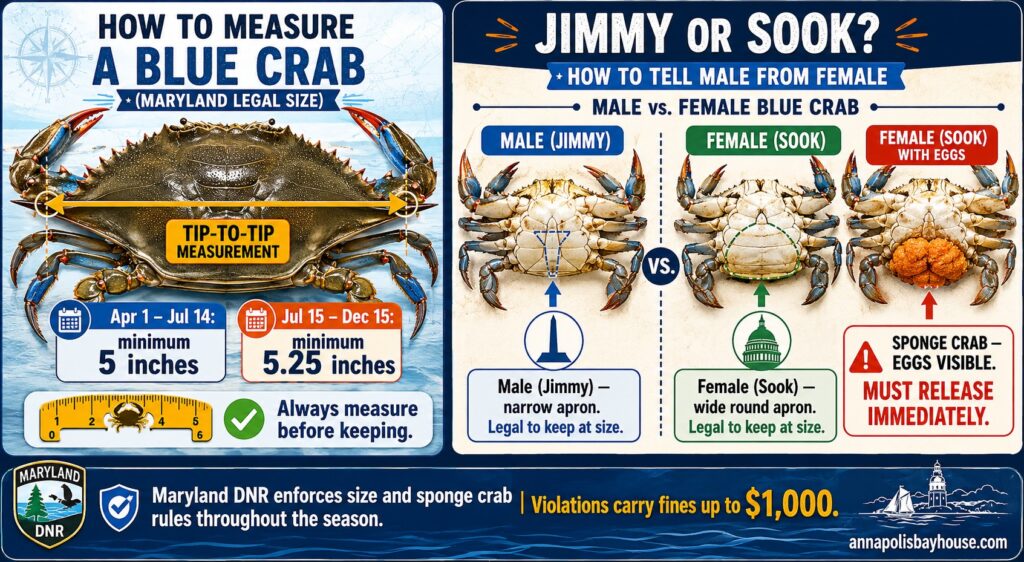
Always verify current regulations directly with Maryland DNR before your trip, as rules can be updated between seasons.
Best Crabbing Spots Near Annapolis
Annapolis and its surrounding waterways offer some of the most productive recreational crabbing in the entire Chesapeake region. Below are the top spots, each with distinct advantages depending on your gear, experience level, and whether you have access to a boat.
South River
The South River consistently ranks as one of the top crabbing destinations in the Annapolis area. The most productive stretch runs between Persimmon Point and Brewer Point, where the river maintains ideal salinity levels for blue crabs. Numerous small creeks feeding the South River, including the aptly named Crab Creek, offer sheltered spots for placing collapsible traps. Because the South River sits away from the busiest Annapolis boat traffic, catch rates stay strong through most of the season.
Rhode River and Carrs Wharf
Carrs Wharf on the Rhode River is a low-profile spot that draws local crabbers rather than tourists. The pier sits close to the water, making it well-suited for hand line crabbing. Because it is located near enough to the Bay to receive good salinity but sheltered from strong current, it produces through most of the summer. Parking is free but limited. Bring your own shade and snacks, as there are no amenities on site.
Sandy Point State Park
Sandy Point State Park, located just outside Annapolis off Route 50, has a dedicated crabbing pier at Mezick Ponds. The protected water at Mezick Ponds is calmer than the open Bay, which makes it easier to manage traps without adding excessive weight. The park has restrooms, picnic tables, and a large parking lot. Arrive before 9 a.m. on summer weekends to secure parking.
Magothy River
The Magothy River, northeast of Annapolis, offers boat-based crabbers miles of productive tidal channels with less pressure than the more popular Severn River. Set traps along the grass beds on the eastern shore of the river for consistent catches from July through September.
Private Dock Access
Private waterfront property consistently outperforms public piers for crabbing across the Chesapeake region. A private dock eliminates crowding, lets you check gear at any hour, and places you directly over water that sees less disturbance than public access points. Guests at a bayfront rental with a private dock can set a collapsible trap before breakfast and return to it after lunch without competing for space or waiting for a tide-exposed pier to clear. Browse Annapolis Bay house rentals with a private dock directly on the Bay at annapolisbayhouse.com.
Dock Crabbing vs. Boat vs. Shore – Which Works Best?
Each platform has distinct advantages. The right choice depends on your experience level, how many crabs you want to catch, and what gear you have available.
Shore crabbing requires no license, no gear beyond string and a net, and almost no preparation. Walk to any tidal waterway in Maryland, tie a chicken neck to a line, and you can be crabbing within minutes. The catch rate is lower than other methods, but for families with young children it is the easiest and most entertaining introduction to the tradition.
Dock crabbing using collapsible traps or net rings significantly increases your catch compared to hand lines. You can set multiple traps at once, leave them soaking for 15 to 30 minutes, and pull them one by one. A private dock over productive water allows you to run this cycle continuously throughout the day. The Annapolis Bay area, including Back Creek and the mouth of the Severn River, holds blue crabs throughout the summer season.
Boat crabbing with a trotline is the most productive method and what commercial watermen use. A 100-foot trotline baited with chicken necks or menhaden can produce dozens of crabs in a single pull when timed with the tide. The technique takes practice and requires a boat, but experienced recreational crabbers regularly fill bushel baskets running trotlines on the South River and Rhode River. A recreational crabbing boat license covers everyone aboard the vessel for $15, removing the need for individual licenses.
When to Go – Peak Season and Tidal Timing
Maryland’s crabbing season opens April 1 and runs through December 15 in the Bay and its tidal tributaries. The peak window for recreational crabbers near Annapolis is July through September, when water temperatures are highest and blue crabs are most active in the shallows.
July and August produce the largest crabs and the highest catch rates, but they also bring the most competition at public access points. September offers a compelling alternative: crabs tend to be fatter heading into fall, crowds thin out noticeably, and weekday trips become far more productive than summer weekends. Many experienced Chesapeake crabbers consider mid-September the single best time of year for quality over quantity.
Tidal timing matters more than most beginners realize. Blue crabs feed most actively during moving water, either an hour before or after the tide change. Slack tide, when the current stops entirely, produces the fewest bites. Check tide charts for your specific location before heading out. The Maryland DNR posts current tide tables at dnr.maryland.gov, or use an app such as Tides Near Me for real-time predictions.
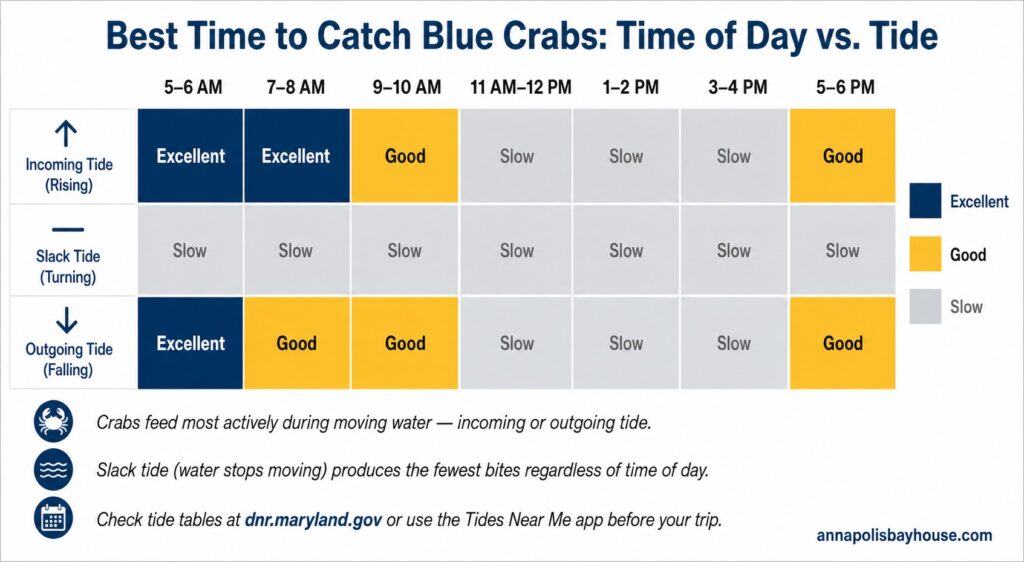
Early morning remains the most productive time of day. Crabs that have been feeding overnight are still active at dawn and will take bait readily before water temperatures climb into midday ranges. If you are working a private dock, setting traps at first light and pulling them through mid-morning is a consistent approach that maximizes your haul before the afternoon heat sets in.
How to Cook Maryland Blue Crabs at Home
Steaming with Old Bay seasoning is the definitive Maryland preparation. Every crab house from Annapolis to Baltimore uses a variation of this method, and it works equally well in a rental kitchen with a large stockpot. The key is to steam the crabs live and coat them generously with Old Bay before the shells seal during cooking.
Classic Maryland Steamed Blue Crabs
What you need: a large steamer pot with a rack or basket, live blue crabs, Old Bay seasoning, coarse kosher salt, apple cider vinegar, and beer (light lager works well).
- Pour equal parts apple cider vinegar and beer (about 1 cup each for a half-bushel of crabs) into the bottom of the steamer pot. Bring to a rolling boil.
- Mix Old Bay and coarse salt in roughly equal proportions in a small bowl. This is your seasoning blend.
- Using tongs, layer the live crabs into the steamer basket. Between each layer, sprinkle the Old Bay and salt mixture generously over the crabs.
- Cover tightly and steam for 20 to 25 minutes, until the shells turn a deep reddish-orange and the legs pull away easily.
- Dump the crabs directly onto a table covered with newspaper or butcher paper. Serve with mallets, small knives, and your choice of drawn butter or plain white vinegar for dipping.
Old Bay seasoning has been made in Baltimore by McCormick since 1939. The blend includes celery salt, black pepper, crushed red pepper flakes, and paprika, among other spices. Use it directly from the can, as it dissolves. Steaming live crabs, rather than killing them first, preserves the texture of the meat and makes it easier to extract cleanly from the shell.
A proper Maryland crab feast is more social event than dinner. Cover the table completely with newspaper, pile the crabs in the center, and let everyone pick directly from the pile. Mallets and small knives or crab picks help extract meat from the claws and body chambers. Cold beer or iced tea completes the picture. Plan for about six to eight crabs per person for a satisfying meal.
Crabbing with Kids – Making It a Full Day
Blue crabbing is one of the best outdoor activities for children in the Chesapeake region. Hand line crabbing requires no special skills, costs almost nothing, and produces immediate results that keep kids engaged. The challenge of slowly lifting a line while a crab clings to the bait is exciting enough to hold attention for hours.
For children under 16 in Maryland, no license is required to use hand lines, dip nets, collapsible traps, or net rings. That covers the full range of beginner gear, meaning kids can participate in the complete experience without any paperwork.
A few practical points for family crabbing trips:
- Use a dock or pier rather than an open boat for children under eight. The stability of a dock removes water-safety concerns and lets kids focus on the crabbing itself.
- Chicken necks are the ideal bait for children because they are cheap, widely available, and durable enough to stay on a line through multiple bites. Tie the bait securely with a simple knot.
- Keep a long-handled dip net ready at all times. When a crab appears at the surface, children need to scoop quickly before the crab lets go of the bait.
- Bring a cooler with ice for storing the catch and a separate small cooler with drinks and snacks. A full day on a dock in July moves quickly.
- Show children how to measure a crab before keeping it. The 5-inch rule (tip to tip across the widest point of the shell) is easy for kids to apply with a ruler, and it teaches the conservation principle of returning undersized crabs.
Waterfront rental properties with private docks eliminate the logistics that make family crabbing trips difficult at public access points: no crowded parking, no strangers at adjacent spots, and the ability to take breaks inside and return to the dock whenever energy levels allow.
Frequently Asked Questions
Do I need a license to go crabbing in Maryland?
It depends on the gear. No license is required to crab with hand lines or dip nets in Maryland. A recreational crabbing individual license is required for trotlines, collapsible traps, and net rings. The license costs $5 for Maryland residents and $10 for non-residents in 2026, and is available online through the Maryland DNR Compass System.
What is the daily crabbing limit in Maryland?
Licensed individual recreational crabbers may keep 1 bushel of hard blue crabs per day. A licensed recreational crabbing boat may hold up to 2 bushels. Unlicensed individuals using only hand lines and dip nets are limited to 2 dozen male crabs per person per day (or 4 dozen with two or more unlicensed people on a boat).
Can you crab from a dock without a boat in Maryland?
Yes. Dock crabbing is one of the most popular recreational crabbing methods in Maryland. You can use hand lines, net rings, or collapsible traps from any dock you have permission to access. Crab pots (standard wire pots) are allowed for recreational use on private property and must be registered with Maryland DNR.
What is the best bait for catching blue crabs on the Chesapeake Bay?
Chicken necks are the traditional and most widely used bait. They are inexpensive, hold up in the water for extended periods, and attract crabs reliably throughout the season. Oily fish such as menhaden or bluefish work well as alternatives, particularly during slack tides. Avoid lean proteins like chicken breast that fall apart quickly.
When is blue crab season in Maryland?
Maryland’s recreational blue crab season runs from April 1 through December 15 in the Chesapeake Bay and its tidal tributaries. The peak window for the largest crabs and highest catch rates is July through September. September is particularly productive because crabs are heavier heading into fall and crowds at public access areas thin out significantly.
Is it safe to eat crabs caught in the Chesapeake Bay?
Yes, blue crabs from the Chesapeake Bay are safe to eat. Maryland DNR publishes fish and shellfish consumption advisories periodically; check dnr.maryland.gov for the latest guidance before your trip. In general, blue crabs from the main Bay and its major tributaries have no active consumption restrictions for healthy adults.
What happens if I catch an undersized crab?
Return it to the water immediately. Maryland requires blue crabs to measure at least 5 inches tip-to-tip from April 1 through July 14, and 5.25 inches from July 15 onward. Female crabs carrying visible egg masses (sponge crabs) must be released regardless of size. DNR officers enforce size limits at public access areas throughout the season.
Can I use a crab pot at a vacation rental property in Maryland?
Yes, provided the pot is registered with Maryland DNR. Registered crab pots on private waterfront property may be set and checked 24 hours a day during the open season. Each pot must display a valid registration tag. The annual registration fee is $5 per pot for Maryland residents. Check current regulations at dnr.maryland.gov for the most up-to-date requirements.
Stay at the Bayfront Home and Crab Right from Your Private Dock
The Annapolis Bay House sits directly on the Chesapeake Bay with a private dock, Adirondack chairs at the water’s edge, and 1.1 acres of waterfront property. Drop your collapsible traps at dawn. Pull them before breakfast. Steam your catch for dinner. Check availability now!