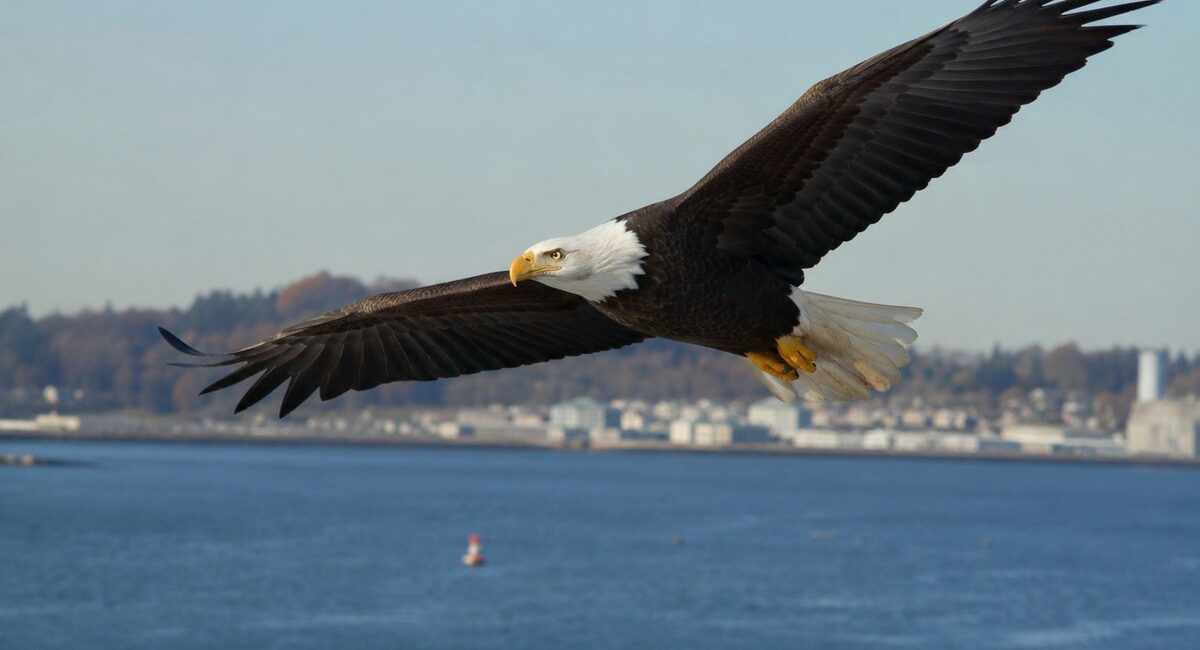
The Chesapeake Bay is the most wildlife-rich estuary in North America, and I say that not as a travel brochure claim but as someone who has spent mornings on a waterfront dock watching an osprey drop like a stone into the water ten feet away. Whether you are planning a family trip or simply want to know what you might actually see, this guide covers the real wildlife of the Chesapeake Bay and when and where to find it.
Key Takeaways
- The Chesapeake Bay is the largest estuary in the United States, spanning roughly 200 miles and supporting more than 3,600 plant and animal species. No other destination on the East Coast concentrates this much wildlife in one accessible region.
- The Chesapeake Bay holds the world’s largest breeding osprey population and one of the highest concentrations of bald eagles on the entire Atlantic coast. That combination of two record-level raptor events in one place is genuinely rare.
- Bald eagles are present year-round and begin nesting as early as January. You do not need to plan a dedicated wildlife expedition to see one.
- Ospreys return each spring, typically in early March, and dive-fish in open water throughout the season. From a waterfront rental with a dock or a screened porch, you may watch this several times a day without leaving the property.
- Every fall, roughly one million waterfowl move through the Chesapeake Bay region along the Atlantic Flyway. The bay also supports river otters, white-tailed deer, bottlenose dolphins, and blue crabs as signature wildlife encounters beyond birds.
- A well-located waterfront vacation rental on the Eastern Shore puts you within thirty to forty-five minutes of multiple federal wildlife refuges and gives you passive wildlife access from the dock or porch itself.
What Is the Chesapeake Bay and Why Is It a Wildlife Hotspot
The Chesapeake Bay is North America’s largest estuary, stretching approximately 200 miles from the Susquehanna River in northern Maryland south to the Atlantic Ocean at the Virginia Capes. Its watershed covers roughly 64,000 square miles across six states and Washington, D.C. When people ask what the Chesapeake Bay is famous for, the short answer is that it is one of the most biologically productive bodies of water on Earth.
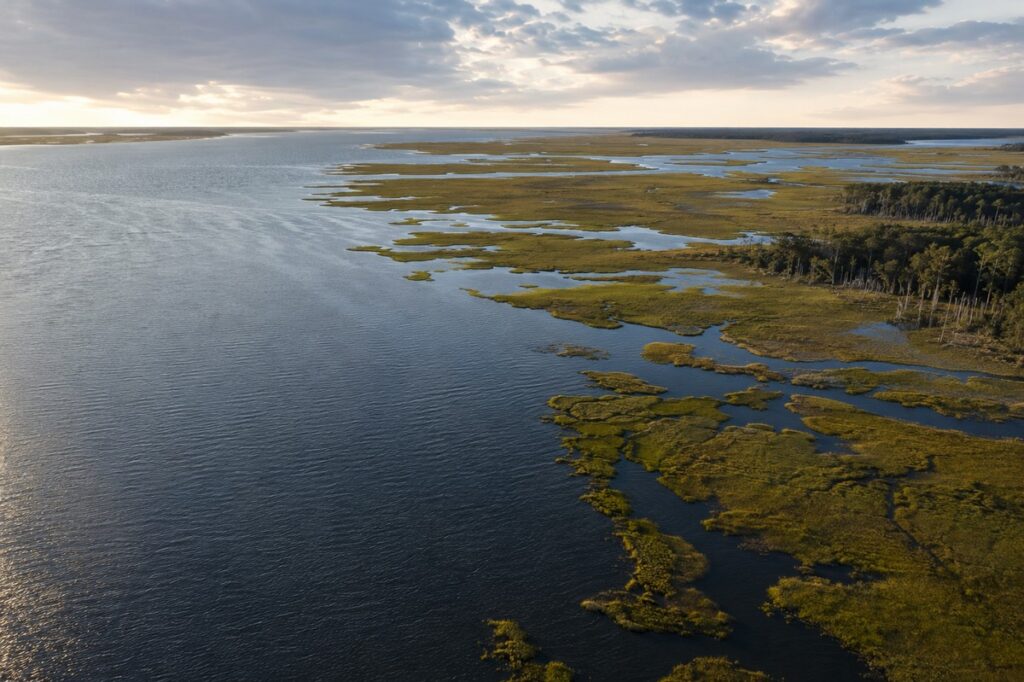
The bay is neither purely saltwater nor freshwater. It is a brackish estuary, meaning that ocean saltwater from the Atlantic mixes with freshwater draining down from inland rivers and streams. That mixing produces an exceptionally rich nutrient base that supports more than 3,600 species of plants and animals, including more than 350 species of fish. Blue crabs, oysters, and striped bass are the most commercially recognized, but the ecosystem that sustains them is the same one that draws eagles and ospreys.
The bay’s tidal marshes and forested shorelines do something that most other coastal habitats cannot: they create layered habitat that supports wading birds, nesting raptors, wintering waterfowl, and mammals simultaneously. Every year, approximately one million waterfowl winter in the Chesapeake Bay region, routed south along the Atlantic Flyway, which runs directly over the bay. That single statistic explains why this estuary consistently ranks among the most important bird habitats on the continent. The Chesapeake Bay Foundation and the Chesapeake Bay Program actively monitor and work to protect this ecosystem, and their data confirm that wildlife populations track closely with water quality improvements.
What makes the bay practical for wildlife visitors is geography. The Eastern Shore of Maryland and Virginia remains largely rural and low-development compared to most mid-Atlantic coastline. Federal wildlife refuges sit within easy reach of most waterfront towns, and in many locations the wildlife comes to you rather than the other way around.
Bald Eagles of the Chesapeake: What to Expect and When to See Them
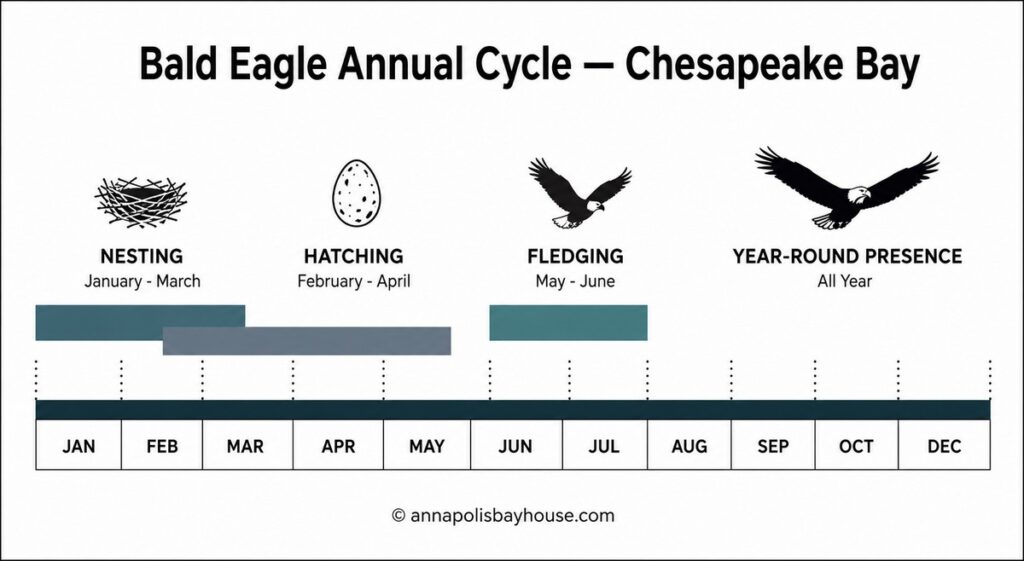
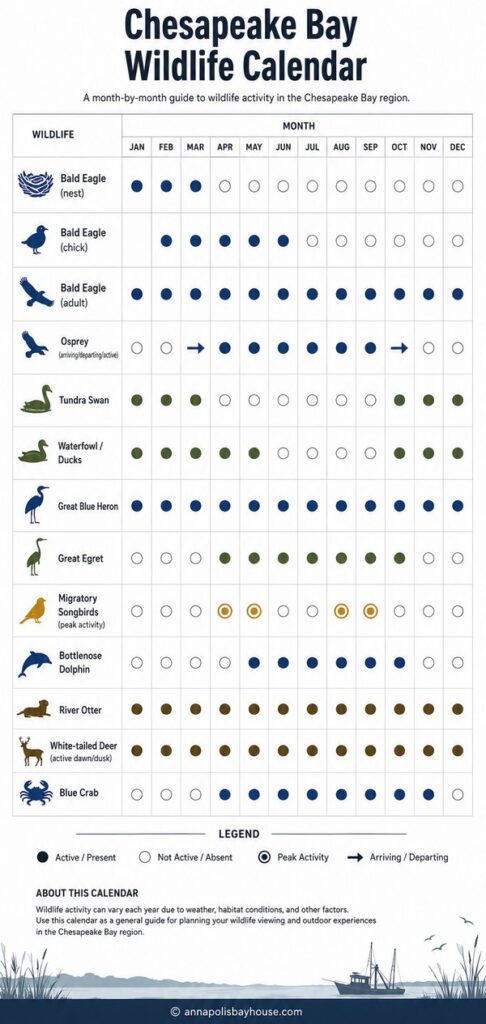
Maryland and Virginia together host one of the highest concentrations of nesting bald eagles anywhere on the Atlantic coast, and the Chesapeake Bay region is the center of that population. Bald eagles are present in the bay area year-round. They do not migrate south in winter the way most people assume. In fact, January and February are some of the best months to spot them because nesting activity begins in January and the leafless trees make nests and perching birds far easier to see.
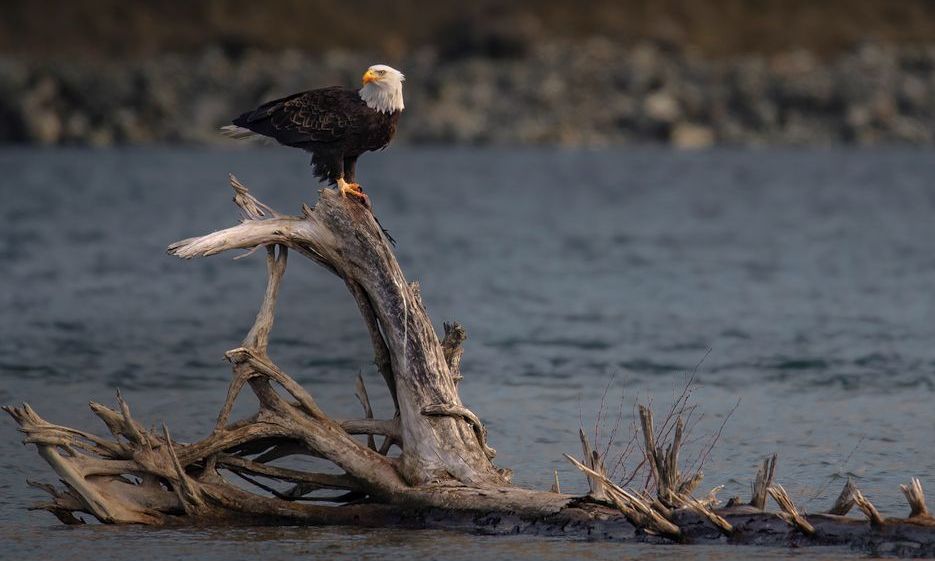
The eagle’s annual cycle around the bay runs roughly as follows: nesting begins in January and continues through March, eggs hatch in February and March, chicks fledge at around ten to twelve weeks which puts the fledging window in May and June, and juvenile eagles then spend the rest of the year learning to fish and hunt. Juveniles are brown and mottled rather than the familiar white-headed adults. That matters practically because juveniles far outnumber adults in most viewing areas, and families new to eagle watching often pass them over without realizing what they have seen. A bald eagle does not develop its fully white head until its fifth or sixth year.
Adult bald eagles have a wingspan of roughly seven feet, making them one of the largest birds most visitors will ever see. When one glides low over open water, identification is immediate.
Blackwater National Wildlife Refuge near Cambridge, Maryland is the single best eagle-watching destination in the region. Established in 1933, it protects tidal marsh, freshwater ponds, and loblolly pine forest along the Little Blackwater River. The refuge is routinely cited as having the highest concentration of bald eagle nesting sites on the Atlantic coast. Eagles can be spotted from the auto tour road in all seasons, though winter visits often yield the most reliably close sightings.
Bald eagles are protected under the Bald and Golden Eagle Protection Act, and their recovery from near-extinction decades ago is one of American conservation’s genuine success stories. The Chesapeake Bay region played a central role in that recovery, and the current population reflects decades of improved water quality and reduced pesticide use.
Ospreys: The Chesapeake’s Most Iconic Nesting Bird
If I had to pick a single image that defines a spring morning on the Chesapeake Bay, it would be an osprey folding its wings mid-air and driving talons-first into the water to pull out a fish. Ospreys are arguably the most charismatic birds that nest on the bay, and the Chesapeake supports the world’s largest breeding population of them. The Chesapeake Bay Foundation uses the phrase “osprey garden” to describe what the bay has become for this species, and that phrase is not hyperbole.
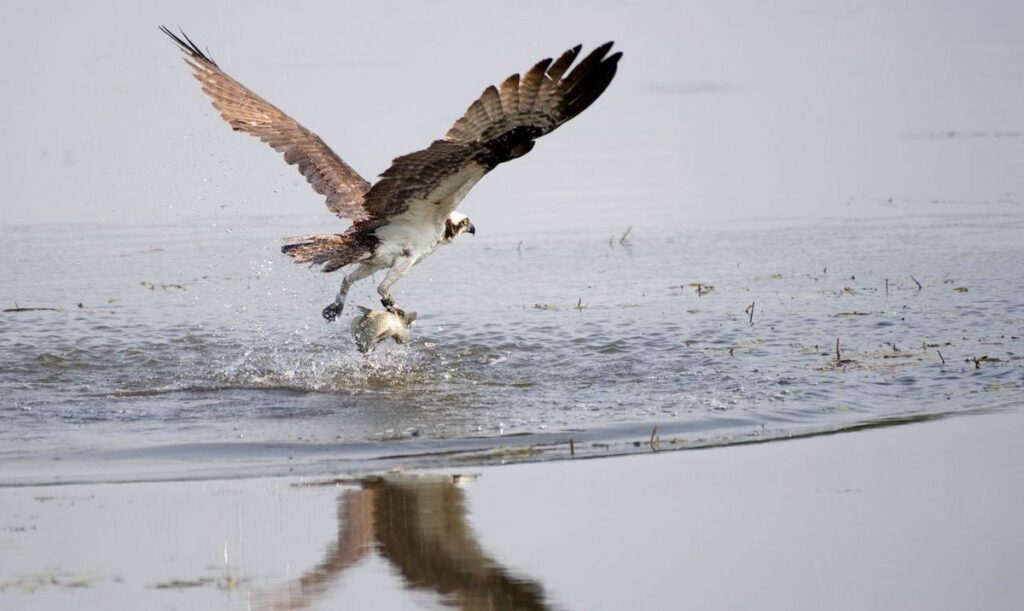
Ospreys (Pandion haliaetus) are migratory, spending winters in Central and South America and returning to the Chesapeake Bay each spring. The first birds typically arrive in early March. They are intensely loyal to their nest sites, returning to the exact same platform or piling year after year. Pairs mate for life, and established couples reunite at the nest site each spring after months apart. Watching a pair rebuild and prepare a nest through late March and April is a behavioral spectacle in itself.
Ospreys are the bay’s indicator species in a meaningful sense. Because they feed almost exclusively on live fish caught from near the surface, their population health reflects the health of the bay’s fisheries and water quality. When osprey numbers are strong, it is a signal that the broader ecosystem is functioning well. The recovery of the Chesapeake osprey population over the past several decades tracks closely with improvements in water quality and the reduction of certain agricultural chemicals.
One practical point for visitors: osprey dive-fishing is not a once-a-day event that requires binoculars at dawn. Active ospreys fish throughout the morning and again in late afternoon. From a waterfront rental with a dock or a porch looking over open water, you are likely to see multiple dive sequences in a single morning without moving from your chair. No other destination I am aware of puts this level of wildlife activity at the literal doorstep of a vacation rental.
The Chesapeake Conservancy operates live osprey nest webcams during nesting season, which are worth checking before your trip to understand the timing of chick hatching relative to your visit.
Other Birds of the Chesapeake Bay Worth Watching
Eagles and ospreys get most of the attention, but they are two species in a region that supports hundreds. The Chesapeake Bay and its surrounding marshes, forests, and beaches are recognized as a globally significant bird area, and the diversity of species present across the four seasons is genuinely impressive. The Atlantic Flyway routes more than a million waterfowl through the region every fall, and the Eastern Shore’s beaches host some of the largest shorebird populations in the entire Western Hemisphere.
Raptors
- Bald eagle (Haliaeetus leucocephalus): year-round resident, nests January through March, juveniles common throughout the year
- Osprey (Pandion haliaetus): arrives early March, departs in fall, dive-fishing visible from waterfront properties
- Peregrine falcon: seen during migration, particularly along barrier islands and bay edges in fall
Wading Birds
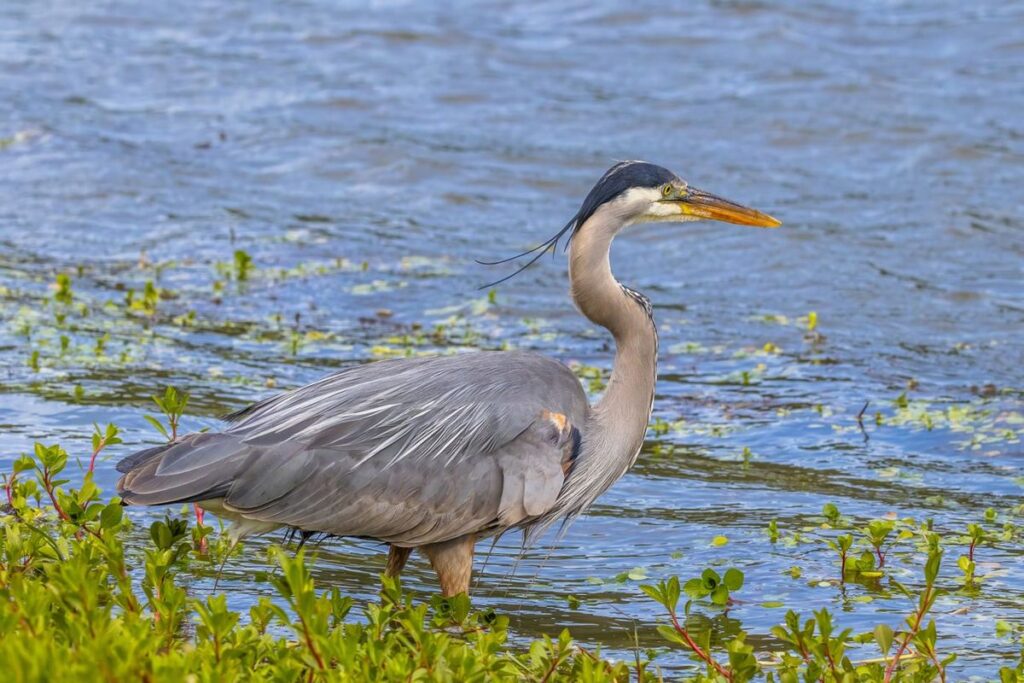
- Great blue heron: the tall, slate-gray wader you will see standing motionless in every tidal creek and marsh edge, year-round
- Great egret: arrives in spring and stays through autumn, recognizable by its all-white plumage and black legs
- American oystercatcher: striking black-and-white shorebird with a long orange-red bill, found on bay beaches
- Least bittern and king rail: secretive marsh birds, harder to spot but present in dense tidal marsh
Waterfowl
- Tundra swan and snow goose: winter visitors in large flocks, most visible November through February
- Canada goose and mallard: year-round residents, ubiquitous along bay shorelines
- Northern pintail and American black duck: seen during fall and winter staging
- Wood duck: nests in wooded areas near water, present through summer
Forest and Marsh Songbirds
- Prothonotary warbler: brilliant golden-yellow wood warbler nesting in the cypress swamps of the Pocomoke River area
- Seaside sparrow: a specialist of coastal salt marsh, rarely seen away from its grass habitat
- Barred owl: common in wooded areas near water, often heard calling at dusk or dawn
A practical tip before any day trip to a wildlife refuge: check eBird, the Cornell Lab of Ornithology’s free bird sighting platform, for recent reports from that specific location. You can see exactly which species other birders have reported at Blackwater NWR or Eastern Neck NWR in the past week, which removes a lot of guesswork from trip planning.
Wildlife Beyond Birds: Otters, Deer, Dolphins and More
The Chesapeake Bay is not only a bird destination. Its marshes, creeks, and open water support a range of mammals and marine life that regularly surprises first-time visitors.
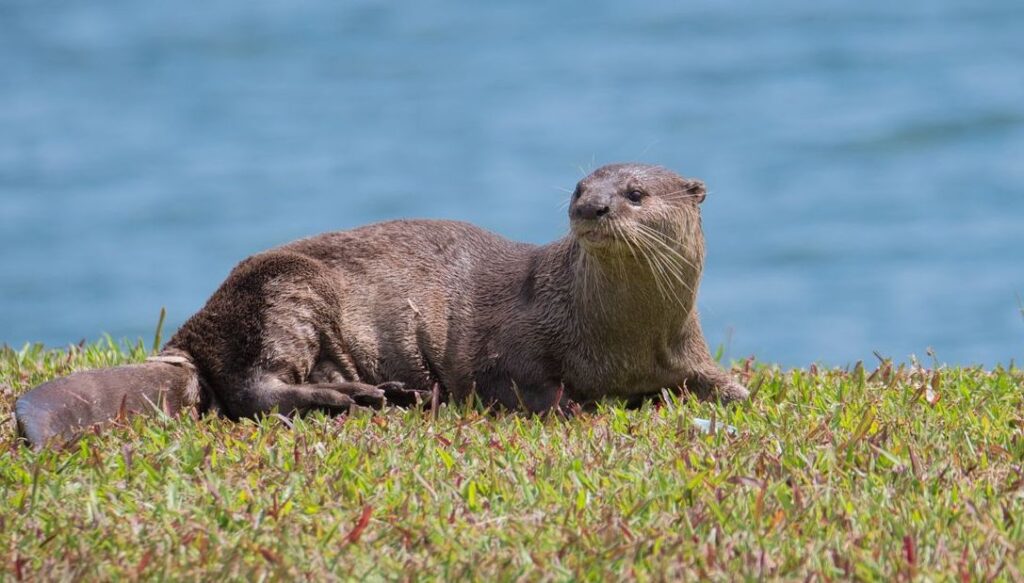
River otters are more commonly seen on the Chesapeake than most people expect. They inhabit tidal creeks and marsh channels and are often spotted at dawn or dusk sliding off a muddy bank or swimming along a dock piling. Ecologically, river otters function as indicator species for waterway health: their presence confirms clean water and a healthy fish population. On the Eastern Shore, they are not rare sightings.
White-tailed deer are active along forested shorelines at dawn and dusk throughout the year. Sika deer, a smaller Asian deer species introduced to the Eastern Shore in the early twentieth century, are also present in the marshier areas near Blackwater NWR. Other mammals you may encounter include muskrat, beaver, American mink, and red fox. Black bears have been documented in some parts of the broader watershed, though they are not common near the bay itself.
Bottlenose dolphins are regularly spotted on guided boat tours out of Chincoteague Island, Cape Charles, and other Virginia bay towns, particularly in summer and fall. They do not venture into the shallower tidal creeks of the upper Eastern Shore, but in the lower bay and off the barrier islands, dolphin sightings are a near-daily occurrence during the warm season.
Blue crabs are the bay’s most iconic species and also a hands-on wildlife experience. Crabbing from a dock with a string, a chicken neck, and a net is a childhood memory for generations of Chesapeake visitors, and it remains completely accessible at most waterfront properties. The Chesapeake Bay provides up to ninety percent of the Atlantic coast’s blue crab harvest in some years, which reflects how central this species is to the bay’s identity. If you plan to crab during your visit, our Chesapeake Bay crabbing guide covers licenses, gear, the best spots near Annapolis, and how to cook your catch.
Striped bass, locally called rockfish, are among the most ecologically significant fish in the bay. The Chesapeake Bay serves as the primary spawning ground for up to ninety percent of the Atlantic striped bass population, which makes it foundational to the entire East Coast fishery. Loggerhead sea turtles, a threatened species, are seasonally present in the lower bay, as are diamondback terrapins in tidal marshes throughout the region.
Best Wildlife Viewing Locations on the Chesapeake Bay
The Chesapeake Bay region has a network of federal and state wildlife refuges that are among the best-managed wildlife viewing areas on the East Coast. Here are the locations that consistently deliver for families and independent visitors.
Blackwater National Wildlife Refuge (Cambridge, MD)
This is the anchor destination for any serious Chesapeake wildlife trip. Established in 1933, Blackwater protects over 28,000 acres of tidal marsh, freshwater ponds, and loblolly pine forest. It holds the highest concentration of bald eagle nesting sites on the Atlantic coast and also supports ospreys, great blue herons, tundra swans, and all five resident duck species common to the Eastern Shore. The auto tour road puts you within close range of active birds year-round. From St. Michaels, Maryland, the drive takes roughly forty-five minutes.
Eastern Neck National Wildlife Refuge (Rock Hall, MD)
A small island refuge at the mouth of the Chester River where it meets the bay. Eastern Neck protects tidal wetlands, agricultural fields, and mixed forest that together attract a wide range of migratory shorebirds in fall and spring. Bald eagles and ospreys are present seasonally, and the refuge is particularly good for migratory waterfowl in fall. From Tilghman Island, the drive takes approximately thirty-five minutes.
Chincoteague National Wildlife Refuge (Chincoteague Island, VA)
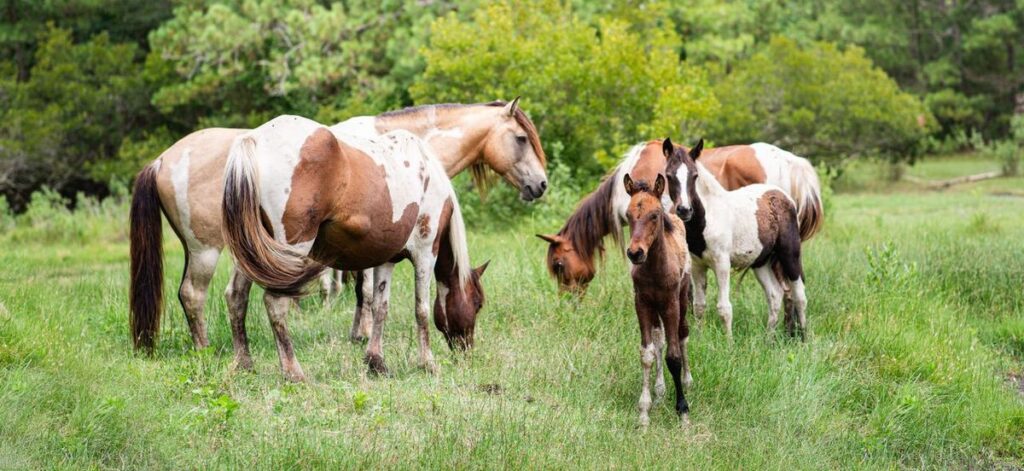
Located on Assateague Island off the Virginia coast, Chincoteague is most famous for its wild ponies, which have lived on the barrier island for centuries. Beyond the ponies, the refuge supports nesting ospreys, bald eagles, shorebirds, and seasonally, bottlenose dolphins in the nearshore waters. It is a full day trip from the mid-Maryland Eastern Shore but well worth the drive for families.
Cape Charles Natural Area Preserve (Cape Charles, VA)
A 29-acre preserve with a boardwalk trail through coastal shrub and forest habitat on the tip of the Delmarva Peninsula. During fall migration, the concentrated bottleneck geography means that hawks, falcons, and songbirds pile up before crossing the bay. It is a compact site but exceptional during the fall migration window in September and October.
Masonville Cove Environmental Education Center (Baltimore, MD)
An urban estuary site on Baltimore’s Middle Branch that hosts an active bald eagle nesting pair visible from the shoreline trail. It is proof that eagles have adapted to suburban environments, and it makes a good add-on for visitors passing through Baltimore.
Calvert Cliffs State Park (Lusby, MD)
Best known for fossil hunting along its eroding cliffs, the park also includes forest trails leading to the bay, where ospreys, herons, and bald eagles are commonly seen over the water. It lies on the western shore, making it a practical option for visitors staying near Annapolis or Solomons Island.
Best Time of Year to Visit for Wildlife
The Chesapeake Bay offers genuine wildlife experiences in every season, which is unusual for a nature destination in the mid-Atlantic. The question is not whether wildlife will be present but which species and behaviors will be most active.
Spring (March through May)
Spring is the peak season for raptor activity. Ospreys return in early March and immediately begin repairing nests and courting. Eagle chicks fledge in May and June, creating a window where juvenile birds are visible learning to fly and hunt. Migratory songbirds are moving through in April and May, including warblers, vireos, and thrushes following the Atlantic Flyway north. Dawn and dusk are the most active periods, but osprey fishing activity is visible throughout the morning.
Summer (June through August)
Summer is when osprey chicks are visible on nests and juvenile eagles are spending their first weeks as independent birds. It is also the best season for shore-based viewing of herons, egrets, and kingfishers in tidal creeks. Bottlenose dolphins are active in the lower bay and coastal waters. Blue crabbing from a dock is at its productive peak from June through September. Wildlife activity early in the morning remains significantly higher than midday.
Fall (September through November)
Fall is the Atlantic Flyway’s peak migration window, and roughly one million waterfowl move through or stop over in the Chesapeake Bay region during this period. Blackwater NWR and Eastern Neck NWR see their largest concentrations of ducks, geese, and swans from October through November. Ospreys depart for Central and South America in September and October. Hawk migration along the bay’s edge and the barrier islands produces excellent falcon and hawk sightings at Cape Charles and other bottleneck sites.
Winter (December through February)
Winter is the most underrated season for Chesapeake Bay wildlife watching, and I include it here specifically because most visitor guides skip it. Bald eagles begin nesting in January, which makes late winter one of the best times to observe nest-building and pair behavior. The bare trees make nests and perching eagles dramatically easier to spot. The winter visitor crowd at refuges like Blackwater is thin, meaning quieter roads and more unhurried viewing. Tundra swans, snow geese, and large flocks of diving ducks are also concentrated on the bay during the winter months in numbers that simply do not exist at other times of year.
How to Watch Wildlife from a Waterfront Rental
The Chesapeake Bay is one of the very few places in North America where trophy-level wildlife — world-record breeding ospreys, high-density bald eagles, river otters, and dolphins — can be observed passively from Chesapeake Bay house rentals without a guided tour or an early-morning hike. That is the proposition that makes a well-located rental fundamentally different from a hotel room or inland cottage. Here is how to get the most out of it.
No effort required: the dock and porch
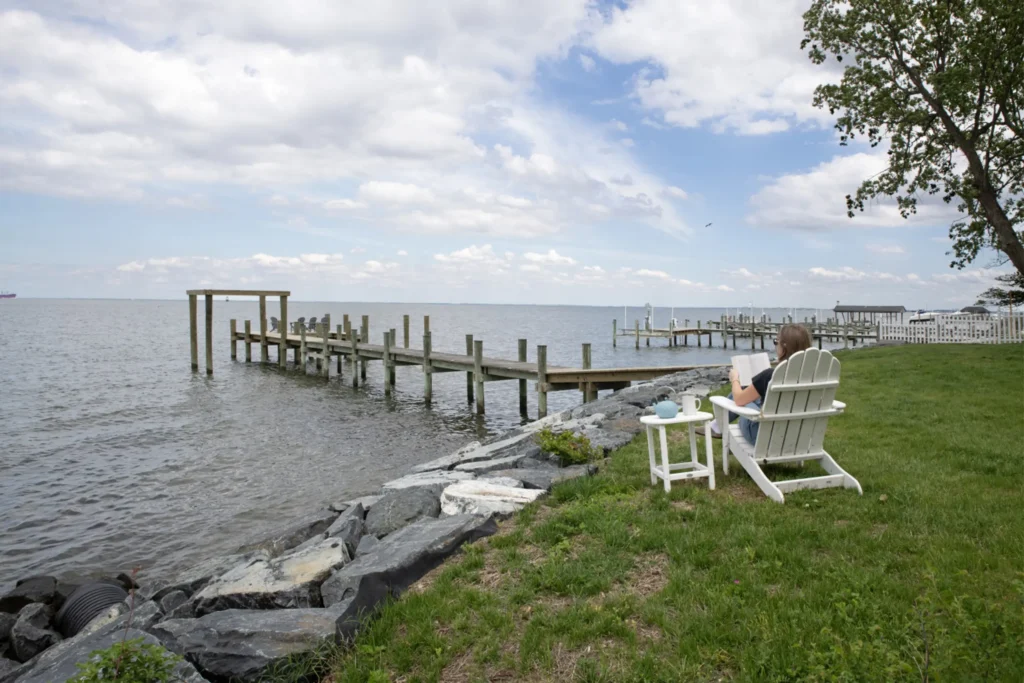
A private waterfront dock is the single most valuable wildlife feature a rental property can offer. Ospreys fish open water repeatedly throughout the morning and afternoon, making multi-sighting days routine from late March through August. Herons hunt along the shore edges at dawn and dusk. River otters occasionally move through, particularly around marsh-edged properties. A screened porch facing the water lets you watch the full dawn activity window without moving from a chair, which for families with young children is a practical advantage that no guided tour can replicate.
Active watching: kayak and canoe access
Rentals with on-site kayaks or canoes extend your wildlife access into tidal creeks and marsh channels that are unreachable from a dock or open water. Paddling a kayak into a marsh creek at dawn is where you are most likely to encounter great blue herons at close range, hear rails, or catch a river otter swimming. The low profile of a kayak also reduces the disturbance effect on nesting birds compared to a motorized boat.
Crabbing from the dock
Crabbing from a dock is often thought of as a food activity, but it is also a direct wildlife encounter with one of the bay’s most ecologically important species. Blue crabs are intelligent, surprisingly fast, and immediately engaging for children. The setup is simple: a string, some bait, a net, and a bucket. Crabbing from a private dock requires no license in most Maryland recreational scenarios, and the experience of catching, identifying, and releasing or cooking a blue crab is one of those hands-on nature moments that stays with a family.
Day trips to wildlife refuges
Waterfront rental towns on the Eastern Shore — St. Michaels, Tilghman Island, Cambridge, and others — are positioned within forty-five minutes of multiple federal wildlife refuges. Blackwater NWR, Eastern Neck NWR, and several state wildlife management areas are all accessible as half-day excursions. Use eBird to check recent sightings before you go, and plan arrival at the refuge for the first hour after sunrise when activity peaks.
Guided boat tours
Guided boat wildlife tours depart from several Eastern Shore towns and from Chincoteague Island and Cape Charles in Virginia. They are particularly useful for dolphin watching in the lower bay and for reaching barrier island beaches where shorebird diversity is highest. If you are staying near Annapolis, the city itself offers sailing tours and on-water charters worth combining with a wildlife day — our guide to things to do in Annapolis for water lovers covers the best options. For eagle and osprey watching specifically, the dock-and-porch approach described above will often outperform a boat tour simply because you can spend more cumulative time watching from a fixed vantage point.
FAQ: Chesapeake Bay Wildlife
Are there bald eagles in Maryland?
Yes. Maryland supports one of the largest bald eagle populations on the Atlantic coast, and the Chesapeake Bay region is the center of that population. Bald eagles are present year-round and are not rare sightings, particularly near tidal rivers and wildlife refuges on the Eastern Shore. Blackwater National Wildlife Refuge near Cambridge is widely regarded as the best single location for eagle watching in the state.
Is the Chesapeake Bay saltwater or freshwater?
The Chesapeake Bay is brackish, meaning it contains a mix of both salt water and fresh water. Ocean saltwater enters from the Atlantic at the bay’s southern end, while freshwater flows in from rivers including the Susquehanna, Potomac, and James. The balance of salt to fresh water varies by location and season. This mixing creates the exceptionally productive estuary conditions that support over 3,600 species.
When do ospreys arrive at the Chesapeake Bay?
Ospreys typically begin returning to the Chesapeake Bay in early March, with most birds back on their nesting territories by mid-March. They remain through the summer, and juveniles from the year’s nests begin departing in late summer and early fall. Adult birds leave by October, heading to wintering grounds in Central and South America. March through August is the primary viewing window.
What fish species live in the Chesapeake Bay?
The bay supports more than 350 fish species. The most ecologically significant include striped bass (rockfish), which use the Chesapeake as a primary spawning ground and account for a large share of the Atlantic coast population. Blue crab, while technically a crustacean, is the bay’s most commercially important species. Other notable species include spot, croaker, menhaden, white perch, bluefish, weakfish, and river herring including alewife and blueback herring.
Are there endangered species in the Chesapeake Bay?
Yes. Loggerhead sea turtles, a federally threatened species, are seasonally present in the lower bay and the Virginia coastal waters. Diamondback terrapins, while not federally listed, face significant pressure from habitat loss and road mortality. The Chesapeake Bay Foundation and the U.S. Fish and Wildlife Service both work on conservation efforts for these and other sensitive species in the watershed.
What is the best time of year to see bald eagles on the Chesapeake Bay?
Bald eagles are present year-round, but January through March is the most productive window for serious eagle watching. Nesting begins in January, which creates intense activity around established nest sites. The bare winter trees make nests and perching birds much easier to spot than in summer. Blackwater NWR is quieter in winter than during peak tourist season, meaning fewer cars on the auto tour road and more undisturbed viewing opportunities.
Can I see wildlife from a vacation rental on the Chesapeake Bay?
Yes, and in a way that is genuinely unusual compared to other destinations. Waterfront properties on the Eastern Shore of Maryland and Virginia with private docks and water views regularly offer osprey sightings, bald eagle flyovers, great blue herons, and occasional river otter encounters without any driving or guided activity. Spring and summer mornings from a dock or screened porch on the bay can easily produce multiple osprey dive-fishing sequences before breakfast. The Chesapeake Bay is one of the few places where this level of wildlife comes to you rather than requiring you to go find it.